
The ISPM 15 mark looks like this:

NL ISO country code (NL)
000 3-digit registration number of the treatment provider
HT / DH Treatment method: Heat Treatment (HT), Dielectric Heating (DH), or Methyl Bromide (MB).
Fuming with methyl bromide (MB) was banned as an alternative treatment method within the EU as of March 18, 2010, due to a ban on the use of methyl bromide. This treatment method is still used in countries outside the EU. This wood also meets the ISPM 15 requirements.
The mark must include a border. Within the border, the IPPC ear of grain and the code components are separated by a vertical line. A hyphen separates the ISO country code from the unique 3-digit registration number of the registered company.
The logo must be legible, durable, and applied to both sides (preferably opposite). The size is not prescribed.
D (dunnage) dunnage
Dune wood is also subject to ISPM 15, and the same requirements apply. However, dunnage is provided with a mark in which the letter 'D' ('dunnage') is added outside the mark. If added, the letter D becomes an integral part of the Dutch mark.
This mark also appears on loose wood, i.e., on wood that can still be made into a product. Below is an example of a mark with the addition of 'D'.
The letter D (dunnage) is added outside the mark and is the same size as the letters placed inside the mark. The distance between the letter D placed outside the frame and the frame may not be greater than the width of the letter D. If added, the letter D becomes an integral part of the Dutch mark.
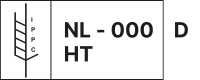
For dunnage, it is important that the marking remains visible even when cutting the wood (for example, by marking along the entire length or by adding an additional marking in a visible location).
Note: Fumigation with methyl bromide (MB) as an alternative treatment method has been prohibited within the EU since March 18, 2010.
More information about the marking can be found in the "Marking" menu.
Wooden packaging bearing the mark guarantees that it meets the requirements of ISPM 15.
Therefore, a separate treatment or other certificate is not required by the manufacturer/repairer/treatment provider/trader.
Furthermore, the invoice must specifically state that the company is registered with SMHV for the supply of treated products that meet the requirements of ISPM 15, with reference to the registration number.
This guarantees that the supplier is actually affiliated with SMHV. Simply stating that the wooden packaging has undergone heat treatment is not sufficient.
Suppliers who meet the requirements of ISPM 15 receive a unique 3-digit registration number, which must be clearly visible in the IPPC mark on the wood. This mark is internationally recognized.
All registered SMHV companies are listed on our website, in both the Dutch and English sections.
If the marking is applied using a template, it must conform to the example shown in the "Marking" menu. If the template deviates, it must be submitted to the Certification Body for approval in advance.
In the Netherlands, loose wood (dunnage) must be marked with a "D" added outside the mark.
This mark is therefore placed on loose wood, i.e., wood that can still be made into a product.
An example of a mark with the letter "D" added can be found in the "Marking Dunnage" menu.
It can be assumed that international marks bearing the IPPC ear of grain, a country code, and a unique number meet the requirements of ISPM 15:
NL ISO country code (NL)
000 3-digit registration number of the treatment provider
HT / DH Treatment method: Heat Treatment (HT), Dielectric Heating (DH), or Methyl Bromide (MB).
Fuming with methyl bromide (MB) was prohibited as an alternative treatment method within the EU as of March 18, 2010, due to a ban on the use of methyl bromide. This treatment method is still used in countries outside the EU. This wood also meets the ISPM 15 requirements.
The mark must include a border. Within the border, the IPPC ear of grain and the code components are separated by a vertical line. A hyphen separates the ISO country code from the unique 3-digit registration number of the registered company.
The logo must be legible, durable, and applied on both sides (preferably facing). The size is not prescribed.
If you have any doubts about the validity of an international mark on wooden packaging, we advise you to contact the Netherlands Food and Consumer Product Safety Authority (NVWA) in Wageningen: email: info@nvwa.nl or via www.nvwa.nl
The requirements for the IPPC logo are described in the inspection protocol.
The logo must be legible, durable, and applied to both sides (preferably facing each other). The size is not prescribed.
The Dutch mark must meet the following requirements:
- the mark must closely resemble the examples provided in the Mark menu;
- the size, font types used, and position of the mark may vary, but it must be large enough to be visible and clearly legible to inspectors without the need for visual aids;
- the mark must be rectangular or square in shape and have a border. The mark must be located within the border.
An exception to this is the use of the letter D to indicate dunnage, which is placed on the right-hand side outside the border; - the mark must be applied permanently and non-transferably;
- it must be affixed in a visible location (visible during use);
- (preferably) on at least two opposite sides;
- the mark must not be drawn by hand;
- the colors red or orange are not permitted, as these colors are used in the labeling of dangerous goods.
Other variations of the mark are not permitted.
Variations in the layout of the mark may be accepted provided they comply with the requirements set out in the SMHV Handbook, Chapter 2.9, and Appendix 2.
Doubts about a mark?
In the Explanatory document for ISPM 15 (Guide to the regulation of wooden packaging materials), you can find examples of correct and incorrect ISPM 15 markings starting from Appendix 7 (page 74).
Stamp Makers
A number of companies have been selected in the Netherlands where the ISPM 15 mark can be stamped.
Kantoorstempels.nl
Tel: +31 (0)85-4881881
Kortho Coding & Marking te Katwijk
Telefoon: 071 - 406 04 70
Posthumus & Dal Graveurs B.V. te Amsterdam
Tel: +31 (0)20 – 614 56 99
Preidel B.V. te Alblasserdam
Tel: +31 (0)78 - 692 08 88
STEMPEL 539
Tel: +31 (0)10 284 71 97
Stempelfabriek.nl
Tel: +31 (0)85 487 49 87
Stempelmakers.NL te Oisterwijk
Tel: +31 (0)13 - 523 07 98
Unimark Office B.V. te Oud-Beijerland
Tel: +31 (0)186 - 61 90 88
de Stempelplaats
Tel: +31 (0)10-404 93 22
A shipment containing wooden packaging may be detained, returned, or destroyed by the relevant country if:
- the wooden packaging is purchased through an unregistered company;
- the number cannot be traced back to a registered supplier;
- the wooden packaging does not bear an IPPC mark;
- the invoice does not specifically state that the company is registered in the SMHV central register for the supply of treated products that comply with the ISPM 15 requirements, with reference to the registration number;
- the wooden packaging is not marked at all or is not marked according to the marking system;
Because the ISPM 15 requirement is increasingly being imposed, it is advisable to ALWAYS use marked wooden packaging, unless the packaging is only used within Europe.
ISPM 15 is not mandatory for packaging that does not leave Europe. See ISPM 15 international country overview: 'European Union'