Mold growth and discoloration sometimes occur on wood/wood packaging. This occurs primarily on undried wood that is heat-treated and then stored in poorly ventilated spaces. Heat treatment can therefore exacerbate the process of mold growth and discoloration.
However, mold has not been identified as a phytosanitary risk for wooden packaging according to ISPM 15. Therefore, any mold growth is not a reason for other countries to refuse packaging wood in accordance with ISPM 15.
The best solution to prevent mold growth and discoloration is to use dry wood (also known as kiln-dried or KD wood). Re-drying wood creates unfavorable conditions for the spread of mold and the development of discoloration. Purchasing wooden packaging that has been heat-treated and dried in accordance with ISPM 15 therefore tackles (quarantine) organisms and prevents mold growth/discoloration.
As a user of wooden packaging, don't take any risks and follow these steps:
- Choose a registered company and verify the registration number: you can find all registered companies in the central register, both in the Dutch and English sections. Each affiliated registered company has a unique 3-digit registration number (NL - 000) that you can verify in the central register.
- Verify the affiliated company's invoice: it should state that the wooden packaging complies with ISPM 15 and that the supplier is listed in the SMHV central register, with a reference to the unique registration number. Simply stating that the wooden packaging has undergone heat treatment is not sufficient.
- Check the IPPC mark: the internationally recognized IPPC mark must be clearly visible and preferably affixed to at least two opposite sides of the wooden packaging. This guarantees that the wooden packaging complies with the ISPM 15 requirements. You can easily verify this. These shipments do not require any other (treatment) certificates; therefore, no additional treatment or other certificate is required for any country.
This guarantees that your supplier is indeed affiliated with SMHV. Simply stating that the wooden packaging has undergone heat treatment is not sufficient.
The EU import requirements for packaging wood apply to all third countries, with the exception of Switzerland. This means that all packaging wood and dunnage imported from a non-EU country must meet the requirements of ISPM 15.
Exception: Portugal
ISPM 15 does not apply to traffic within the European Union; however, as of January 1, 2010, all coniferous packaging and dunnage wood leaving mainland Portugal must comply.
The Netherlands Food and Consumer Product Safety Authority (NVWA) strongly recommends that packaging wood also be treated and marked in accordance with ISPM 15 when imported into Portugal.
Exception: Switzerland
Switzerland is not an EU member, but is also not considered a 'third country'. Switzerland imposed requirements for packaging wood in accordance with ISPM 15 as of July 1, 2004. These requirements do not apply to shipments from the Netherlands or other EU member states. The requirements are:
- Packaging wood and dunnage (except wood < 6 mm and wood made using glue, heat, or pressure) must be treated (HT or MB) and provided with an ISPM 15 mark. Dunnage: As of January 1, 2008, dunnage wood must be marked when imported into the EU!
- As of July 1, 2009, all packaging wood must be debarked when imported into the EU. Wood packaging material must be free of bark, except for pieces of bark that:
- Are either narrower than 3 cm (regardless of length),
- Or, if wider than 3 cm, have a surface area of no more than 50 cm² in accordance with ISPM 15.
Within the European Union
ISPM 15 does not apply to cross-border traffic within the European Union (including Switzerland). For European countries that are not members of the EU, this means that packaging wood (1 March 2005) and dunnage wood (1 January 2008) must meet the requirements of ISPM 15 in order to be imported into one of the EU countries.
No, this shipment is considered wood. See the menu 'ISPM 15 International', submenu 'Import of loose wood to Europe'.
Please note: if they are on a pallet, the bottom pallet is considered packaging wood!
The requirements for import packaging by various countries (listed alphabetically) are listed in the "ISPM 15 International Country Overview" menu.
If the country you're looking for isn't listed in the international country overview, the Netherlands Food and Consumer Product Safety Authority (NVWA) doesn't know how the country handles packaging wood and ISPM 15. Sometimes countries don't disclose that they comply with ISPM 15 or have implemented it, but they do comply with it when importing. Therefore, it's recommended to use ISPM 15-treated and marked packaging wood for these countries as well.
The ISPM 15 mark looks like this:
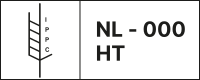
NL ISO country code (NL)
000 3-digit registration number of the treatment provider
HT treatment method: Heat Treatment (HT)
The mark must include a border. Within the border, the IPPC logo and the code components are separated by a vertical line.
The ISO country code must be separated from the unique 3-digit registration number of the registered company by a hyphen.
D (dunnage) loose wood / dunnage
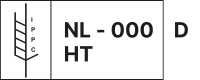
Loose wood is marked with a letter 'D' to indicate dunnage ("Dunnage"), which is added outside the mark. This mark is therefore placed on loose wood, i.e., on wood that can still be made into a product. Below is an example of a mark with the addition of 'D'.
The letter D (dunnage) is added outside the mark and has the same size as the letters placed within the mark. The distance between the letter D placed outside the frame and the frame may not exceed the width of the letter D. If added, the letter D becomes an integral part of the Dutch mark.
For dunnage, it is important that the mark remains visible even when shortened (for example, by marking along the entire length or by adding additional marking in a visible location).
More information about the mark can be found in the "ISPM 15 National" menu.
Note: Fumigation with methyl bromide (MB) has been prohibited as a treatment method since March 18, 2010.
Doubts about a mark?
In the Explanatory document for ISPM 15 (Guide for the regulation of wooden packaging materials), you can find examples of correct and incorrect ISPM 15 markings starting from Appendix 7 (page 74).
Loose wood is marked with a mark where the letter "D" is added outside the mark to indicate dunnage. This mark is therefore placed on loose wood, i.e., wood that can still be made into a product. Below is an example of a mark with the addition of "D."
The letter "D" is added outside the mark and is the same size as the letters placed inside the mark. The distance between the letter "D" placed outside the frame and the frame may not be greater than the width of the letter "D." If added, the letter "D" becomes an integral part of the Dutch mark.
For dunnage, it is important that the mark remains visible even when the wood is shortened (for example, by marking along the entire length or by adding an additional mark in a visible location).
Wooden packaging bearing the mark guarantees that it meets the requirements of ISPM 15.
Therefore, a separate treatment or other certificate is not required by the manufacturer/repairer/treatment provider/trader.
Furthermore, the invoice must specifically state that the company is registered with the SMHV register for the supply of treated products that meet the requirements of ISPM 15, with reference to the registration number.
This guarantees that the supplier is actually affiliated with SMHV. Simply stating that the wooden packaging has undergone heat treatment is not sufficient.
Suppliers who meet the requirements of ISPM 15 receive a unique 3-digit registration number, which must be clearly visible in the IPPC mark on the wood. This mark is internationally recognized.
All SMHV registered companies are listed on our website, both in the Dutch and English sections.
Wooden packaging bearing the mark guarantees that it meets the requirements of ISPM 15.
Therefore, a separate treatment or other certificate is not required by the manufacturer/repairer/treatment provider/trader.
Furthermore, the invoice must specifically state that the company is registered with the SMHV register for the supply of treated products that meet the requirements of ISPM 15, with reference to the registration number.
This guarantees that the supplier is actually affiliated with SMHV. Simply stating that the wooden packaging has undergone heat treatment is not sufficient.
Suppliers who meet the requirements of ISPM 15 receive a unique 3-digit registration number, which must be clearly visible in the IPPC mark on the wood. This mark is internationally recognized.
All SMHV registered companies are listed on our website, both in the Dutch and English sections.
The NVWA has indicated that it cannot recognize foreign sawmills until they have received and approved an official description from the official body in the relevant country.
Once this has been received and approved by the NVWA, the registered foreign sawmills will be recognized. These will then be posted on the SMHV website, and the treated wood from one of these sawmills can then be considered treated. See ISPM 15 international country overview.
If the company meets these requirements from the SMHV Manual, it can apply to one of the Certification Bodies (CBs) with which SMHV has an agreement.
These three CBs are accredited by the Dutch Accreditation Council (RvA).
Each company enters into an agreement with one of the three CBs.